Powered By Blogger

Saturday, March 5, 2011

One of the Oldest castles in Ireland to stay- And yes, there are ghosts!!!

Smarmore Castle- Ardee Ireland

Smarmore Castle has been described as one of the top five places to sleep in Meath and Louth in the current edition of the Lonely Planet guidebook. This guide describes the castle as follows:
“One part medieval fortress and one part luxurious country home, this 14 th-century castle has been converted into a very smart boutique hotel. The six rooms, from the four-postered Viscount’s room in the castle tower to the family-friendly Count’s room, all offer a range of experiences, from courtly Knight to country gent. There’s also a pretty decent fitness centre on the premises. It is situated 6km south of Ardee.”


This is the Earl's Room- Very cozy during the day with views out the front lawn and courtyard/paddock.  Now at night, some very noisy and active ghosties got my attention--- EVERY NIGHT FOR A WEEK STRAIGHT!!  I shared this room with Dr. Ethel Linville (Atlanta, GA) who can corroborate all my tales.
click the link blow to see more of the castle-


Ireland Castle Accommodation - Louth Accommodation

Friday, March 4, 2011

The New Moon and its significance

It seems Earth's Moon has been worshiped since the beginning of time. Its powerful pull on the Earth  affects weather, tides in our oceans. Many believe since the human body is made up of 80% water, then we as flora and fauna are also under its gravitational influence.

The New Moon is when the sky is at its darkest- you cannot see the moon from the Earth and this happens every 28 days.  Because the sky is void of it's largest nighttime luminary, people make decisions on what they want to cast off. Individuals use rituals, say prayers, or execute plans of action.  

The best cliche I can use to reinforce this point is;
"Out with the old, in with the NEW."  

(This saying is a reference to the moon phases in case you didn't already know.)

I say-" When the moon is away, my new life starts today!"

Personally, I make a mental list leading up to the new moon, and think about what negative aspects are in my life that I would like to cast off to beyond all space and time- then start on a course for changes when the moon is not in the sky.  

This is a good exercise for those who like being mindful or present in their life each day.  Junk can accumulate and weigh us down.  It is nice to know at night if there is no moon in the sky, you are reminded to empty the trash in your lives as well.  At the same time new opportunities need to be considered.  The New Moon is when you make statements on how your life should be, where you want to attract personal growth and gain something in your life both tangible and intangible.

Listed are some things people do when the moon is "New."
- look for lost items
- start a new relationship or romance
- change hair color, or style
- buy a new house 
fix your car 
buy clothes 
- bring home a new pet (animals are the easiest to handle during this moon phase)
- get a loan
- hire an employee

********************************************************************************************************
Farmers/Gardeners can use this rule of thumb during a new moon-to a waxing moon

Transplanting-  trees, bushes, or seedlings

Planting crops/flowers that grow above the soil

Remember, the New Moon is used for personal growth, healing, the blessing of a new project.


Wednesday, March 2, 2011

Save Our National Parks! - Take Action Today @ The Hunger Site

Save Our National Parks! - Take Action Today @ The Hunger Site

HOW THE MONTHS GOT THEIR NAMES

This is a very interesting exercise in that many of us forgot that grade school Latin class when we learned the names of the months, or when we studied History, English, and Mythology in school, the stories of  Roman Gods were told. 


In Art, Literature, and History, western Civilization went by the Roman Julian Calendar for over 1500 years.  We can accurately convert Roman dates after 58 BC relative to the start of the Julian calendar, precursor to the Gregorian calendar (1582) that we use today.


We can start getting comfortable with dialog about Metaphysics by talking about something as mundane as the names of months.  No one can argue that beliefs in Pagan Gods/Goddesses are wicked or negatively label the subject, when they themselves use these words in the Western World everyday.


We can accurately convert Roman dates after 58 BC relative to the start of the Julian calendar, precursor to the Gregorian calendar (1582) that we use today.


Enjoy- Mimi

JANUARY
Named for the Roman God Janus, he was considered protector of gates and doorways. Janus is depicted with two faces, one looking into the past, the other facing the future. Janus is the God of new beginnings.


FEBRUARY
From the Latin word februa, meaning "to cleanse." The Roman Februalia was a month of purification and atonement.

MARCH
Named for the Roman God of war, Mars. This was the time of year to resume military campaigns that had been interrupted by winter.

APRIL
From the Latin word aperio, "to open (bud)," because plants begin to grow in this month.

MAY
Named for the Roman Goddess Maia, who oversaw the growth of plants. Also from the Latin word maiores, "elders," who were celebrated during this month.

JUNE
Named for the Roman Goddess Juno, patroness of marriage and the general well-being of women. The word is also derived from the Latin word juvenis, meaning young people.

JULY
Named to honor Julius Caesar (100 B.C.– 44 B.C.). In 46 B.C., Julius Caesar made one of his greatest contributions to history with the development of the Julian calendar, the precursor to the Gregorian calendar we use today.

AUGUST
Named to honor the First Roman emperor,(and grandnephew of Julius Caesar), Augustus Caesar lived from(63 B.C.– A.D. 14).

SEPTEMBER
From the Latin word septem, "seven," because this had been the seventh month of the early Roman calendar before Julius Caesar's calendar reform.

OCTOBER
From the Latin word octo, "eight," because this had been the eighth month of the early Roman calendar.

NOVEMBER
From the Latin word novem, "nine," because this had been the ninth month of the early Roman calendar.

DECEMBER
From the Latin word decem, "ten," because this had been the tenth month of the early Roman calendar.

Tuesday, March 1, 2011

HOW THE MONTHS GOT THEIR NAMES

This is a very interesting exercise in that many of us forgot that grade school Latin class when we learned the names of the months, or when we studied History, English, and Mythology in school, the stories of  Roman Gods were told.  In Art, Literature and civilization, we go by the Roman Julian Calendar- (collectively speaking used as a world wide standard).  We can start getting comfortable with dialog about Metaphysics by talking about something as mundane as the names of months.  No one can argue that beliefs in Pagan Gods/Goddesses are wicked or negatively label the subject, when they themselves use these words in the Western World everyday.
Below is a brief list to help trigger memory- haha.
We can accurately convert Roman dates after 58 BC relative to the start of the Julian calendar, precursor to the Gregorian calendar we use today.
Enjoy- Mimi

JANUARY
Named for the Roman God Janus, he was considered protector of gates and doorways. Janus is depicted with two faces, one looking into the past, the other facing the future. Janus is the God of new beginnings.


FEBRUARY
From the Latin word februa, meaning "to cleanse." The Roman Februalia was a month of purification and atonement.

MARCH
Named for the Roman God of war, Mars. This was the time of year to resume military campaigns that had been interrupted by winter.

APRIL
From the Latin word aperio, "to open (bud)," because plants begin to grow in this month.

MAY
Named for the Roman Goddess Maia, who oversaw the growth of plants. Also from the Latin word maiores, "elders," who were celebrated during this month.

JUNE
Named for the Roman Goddess Juno, patroness of marriage and the well-being of women. Also from the Latin word juvenis, "young people."

JULY
Named to honor Julius Caesar (100 B.C.– 44 B.C.). In 46 B.C., Julius Caesar made one of his greatest contributions to history: With the help of Sosigenes, he developed the Julian calendar, the precursor to the Gregorian calendar we use today.

AUGUST
Named to honor the first Roman emperor (and grandnephew of Julius Caesar), Augustus Caesar (63 B.C.– A.D. 14).

SEPTEMBER
From the Latin word septem, "seven," because this had been the seventh month of the early Roman calendar.

OCTOBER
From the Latin word octo, "eight," because this had been the eighth month of the early Roman calendar.

NOVEMBER
From the Latin word novem, "nine," because this had been the ninth month of the early Roman calendar.

DECEMBER
From the Latin word decem, "ten," because this had been the tenth month of the early Roman calendar.

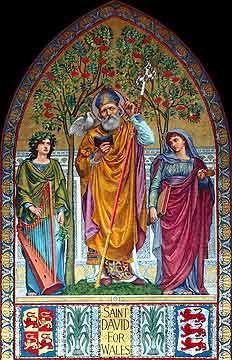
March 1 - Today is Saint David's Day, the Patron Saint of Wales

St David for Wales
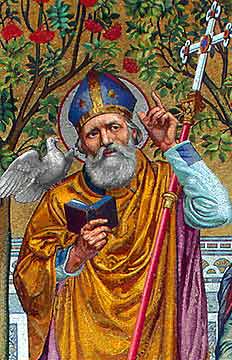
Saint David (St. Dewl)


Today people in Wales celebrate their Patron Saint- St. David.

(3) St David for Wales


His traditional emblem is the dove, and he appears here between figures representing the bardic tradition (harp, mistletoe and oak) and that of learning (book and lamp of learning). 
The work of Sir Edward Poynter

Individuals wear a Daffodil on this day in remembrance 

Mimi Pritchett Louiso: Link To Us @ The Rainforest Site

Mimi Pritchett Louiso: Link To Us @ The Rainforest Site: "Link To Us @ The Rainforest Site"